Monday, 3 March 2014

Unintentional Seapunk Pixel Art from Turkish Apartment Blocks

In 2010, I came across these two apartment blocks, closely located, in the back alleys of the Baglarbasi district, on the Asian coast of Istanbul. An unknown artist had decorated them with a pixel-art-like assortment of mosaics showing dolphins, orcas and ships.

 I wondered about this orca fixation - after all no orcas live anywhere close to Istanbul. The apartment blocks date from the early 90's, so I imagined that maybe, just maybe, the decorator was inspired by the 1993 blockbuster Free Willy.

These weird mosaics also reminded me of seapunk, the 2010s online subculture that revolved around intentionally tacky imagery of oceans, dolphins, orcas, crystals and the like.

Who knows what other weird things might be lurking in the tangled streets of Istanbul?

www.cmkosemen.com

Thursday, 27 February 2014

The Siren of the Red Island


In June 2013, my wife and I hired this yellow pedal boat and embarked on a journey to a nearby rocky islet near the Bodrum peninsula. We were on an adventure with an artistic twist.


The island loomed closer as we pedaled. Bright yellow bushes and a cactus patch became visible. We nicknamed this island "the red island" due to its crimson volcanic rocks.


A view after our landing. The reddish volcanic stones that made up this island were unique - the nearby bay had no rocks of this colour or composition.


The coast of the islet that faced the open sea was made up of wind-and-wave-swept rocks of a greyish colour.


We saw this unfortunate seagull that had swallowed a fishing line and died - a poignant reminder of the casual evil brought about by people's everyday activities.


An interesting detail was this colourful, succulent plant that had barely held on to life among the volcanic rocks. It had even managed sprout flowers!


 But we weren't on the island just to explore. I'd been coming to this island repeatedly over the past few years, and was convinced that a smooth, wall-like section of the rock on its seaward side would make an ideal spot for a rock painting.

I unpacked some buckets of paint and brushes I'd brought along for this purpose, and got to work under the blistering sun. My wife was kind enough to wait for me and photograph my progress.


I wanted to decorate the rock with a large, siren-like monster. The eyes were the first...


...followed by the head.


In less than half an hour, the body, head and the arms of the Siren took form.


When the basic form was done, I gave the Siren a speckling of "stars," made by daubs of white paint from my thumbs. All paints used in this piece were water-based and biodegradable.


A few more touches, and it was ready! Notice how quickly my face got burned in the blistering Aegean sun.


We left the Siren there, facing the open sea between Turkey's Aegean coast and the waters of Greece. I hoped to visit it again next summer, and see how it had fared through the winter.


You can see the Siren at these coordinates. If you see it, can you send me a photo as well?


Monday, 24 February 2014

Small Snakes

In May 2005, I went trekking in the hills of Olympos, and started turning over stones and boulders. Soon I encountered two strange, pink, serpentine reptiles.


The first looked for all the word like a reptilian worm. It was not a snake, but an amphisbaenian, superficially snake-like relatives of Lacertid lizards. This guy was of the species known as Blanus strauchi. It moved like a true earthworm or a gigantic caterpillar, shuffling back and forth inside its loose, scaly skin.


A while later I came across a true snake. This creature, with its tiny, pinprick-like eyes, was a Typhlopid blindsnake, Xerotyphlops vermicularis.

Although they looked similar, these animals were not close relatives. The selective forces of evolution had given them similar forms, weeding out all excess features for a burrowing life. Without limbs, tails, ears and even eyes, they were among the most minimal of all backboned animals.

I wanted to keep these critters as pets, but I knew I couldn't take good care of them if I took them home. I released them back into their burrows and continued with my trek.


Tuesday, 4 February 2014

Two Encounters with Weevils

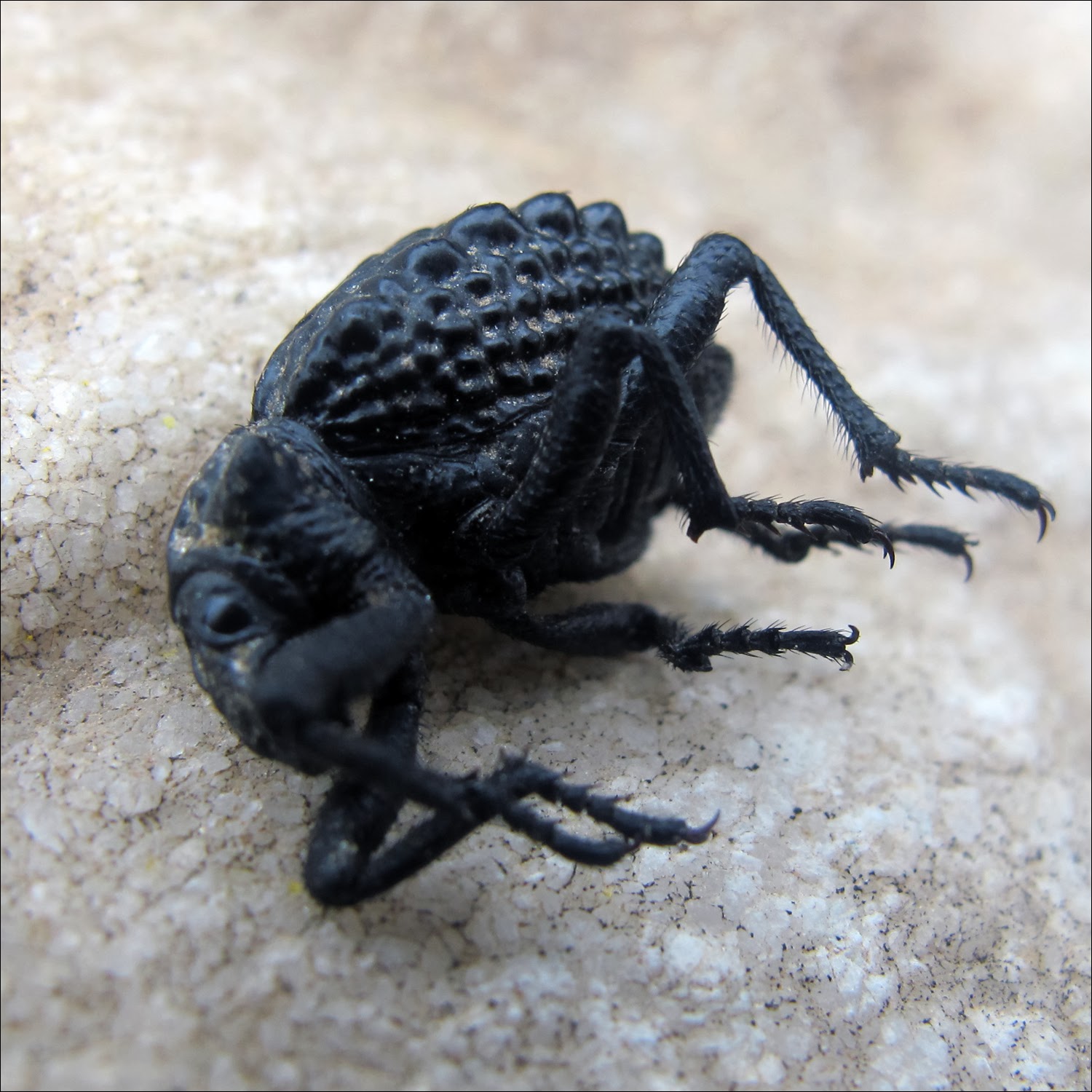
On various times and places, I came across beetles from the Curculionoidea superfamily. Known commonly as weevils, they are characterized by long, chitinous snouts that carry their mouthparts. When viewed closely, their faces look like they are wearing little gas masks. 

Here are two weevils from my travels:


I found this shy customer in front of the Nişanyan Hotel in Şirince, a town in Aegean Turkey. It had a gnarly, armoured carapace. It looked similar to the genus Aades, but I couldn't come up with a proper identification.


This one landed on my knee randomly while I was out in a park in 2010. It had a very long snout and also two very large, cute-looking eyes. It was possibly a Curculio nucum, the oak-boring weevil. This species used its comically-elongated proboscis to bore oak acorns and lay eggs inside.

Weevils are an enormously diverse and understudied group, much more can be written about them.

www.cmkosemen.com

Master of the Butter Men

In Taksim, the chaotic "heart" of Istanbul, there is a salad bar with a secret. One of the guys who works there makes weird, "outsider art" sculptures out of butter and places them on the storefront display, replacing them every few days. I have been photographing this "master of the butter men" since 2011, here are a few of his works.


A weird "lion," 2011.


A cobra snake, 2012.


Man with a mustache, 2012.


A self portrait made of butter, 2012.


A strange reptilian face, 2013. The guy called this figure a "djinn."


Dopey face, 2013.


A bull, 2012.


Face with tongue, 2011.


A cat or a mouse, 2012.

UPDATE:
This artist has become something of a celebrity in Turkish cyberspace, and weird butter sculptures have cropped up in numerous salad bars and fast-food stands since I wrote this post. Besides the pictures I shot, many people have since shared photographs of other weird butter sculptures.
Here is an extended selection:


Thursday, 23 January 2014

Sign Painting in Turkey

Last week, I saw my friend Deniz Tekkul's blog about hand-painted signs in Istanbul and elsewhere in Turkey.

Coincidentally, I had also been collecting the same kind of images or years. So here, dear readers, is my sampling of hand-painted signs from the streets of Istanbul. They look interesting in an age of computer-manufactured blandness.


Update (2018):

More than four years later, I published hese signs, and many more, as a new book: The Disappearing City: Hand-painted Apartment Signs and Architectural Details from 20th-Century Istanbul. You can find out more about it on the books section of my website!